Responsible Humans
Responsibility, Stewardship, and Human Alignment in an AI-Shaped World
Responsible Humans → Annex → The Center of Gravity
The Center of Gravity
1. The Coherence Problem:
Most failures of stewardship begin with small misalignments. Values remain. Decisions continue. Processes function. Responsibilities exist. Yet over time, the connections between them weaken.
What was once coherent gradually fragments into separate parts moving in different directions.
The previous seven practices protect the components. The Center of Gravity protects the coherence between them.
2. What Pulls Us Away?
As explored throughout the essay, coherence is challenged by forces that favor speed over reflection, convenience over capability, dependency over autonomy, short-term gains over long-term consequences, and optimization over stewardship.
Some are AI dependent, others are human dependent. None of these forces are necessarily harmful on their own. The problem appears when they begin pulling different parts of organizations and human systems in different directions.
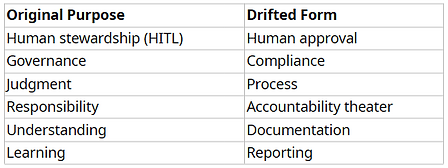
Drift rarely announces itself. Systems often continue functioning while coherence erodes. The original purpose remains visible, but the underlying intent becomes increasingly disconnected from everyday decisions and behaviors.
The examples above illustrate how coherence drifts in practice. The drift often goes unnoticed. But return is intentional.
Returning to the center requires reconnecting the elements that drifted apart.
The Center of Gravity is the discipline of noticing the drift and returning to what keeps values, judgment, action, and responsibility aligned.
3. Returning to the Center
When coherence begins to erode, the following realignments help return to the center:
Reconnect Actions to Intentions.
Why are we doing this?
Do our actions still serve the purpose we originally intended?
Reconnect Incentives to Values.
What behaviors are our systems and incentives encouraging?
Are they aligned with what we claim to value?
Reconnect Judgment to Reality.
What comes from observation?
What comes from assumptions, forecasts, expectations, or models?
Reconnect Capability to Stewardship.
What new capabilities do we expect to gain?
How will our capacity to govern their outcomes keep pace?
Reconnect Responsibility to Consequences.
What consequences (not only outputs) are we creating?
Who will experience them?
Are those consequences visible where decisions are being made?
4. Final Reflection
Coherence is rarely lost all at once. It drifts away one compromise at a time and returns one conscious choice at a time.